Medically reviewed by Benjamin M. Woodhead, DO | Reviewed June 2026
Shoulder impingement syndrome is a common reason patients come to see me with shoulder pain. The name sounds complicated, but the core idea is fairly straightforward: the tendons of the rotator cuff get compressed in the space beneath the top of the shoulder blade, and that compression leads to pain, inflammation, and, over time, difficulty using the arm normally. If you’ve been waking up with a nagging ache in your shoulder, struggling to reach overhead, or noticing that certain movements just don’t feel right anymore, shoulder impingement syndrome may be worth understanding.
Key Takeaways
- Shoulder impingement syndrome develops when the rotator cuff tendons become compressed in the subacromial space, the narrow gap beneath the top of the shoulder blade.
- Overhead activity, repetitive use, posture, and certain anatomical factors can all contribute to impingement.
- Most patients improve with conservative treatment, including physical therapy, activity modification, and anti-inflammatory medications.
- When symptoms persist despite consistent conservative care, arthroscopic surgery may be considered.
What Is Shoulder Impingement Syndrome?
To understand impingement, it helps to know a bit about how the shoulder is built. The rotator cuff, a group of four muscles and their tendons, wraps around the top of the upper arm bone and keeps it centered in the socket during movement. Above the rotator cuff tendons sits the acromion, a bony projection at the top of the shoulder blade, and a small fluid-filled sac called the subacromial bursa that cushions the tendons as they move.
The space between the top of the rotator cuff and the underside of the acromion is called the subacromial space. In a healthy shoulder, there’s just enough room for the tendons to glide smoothly during arm movement. When that space becomes reduced, either from inflammation, bony changes, poor shoulder blade mechanics, or other factors, the tendons can get pinched. That is impingement.
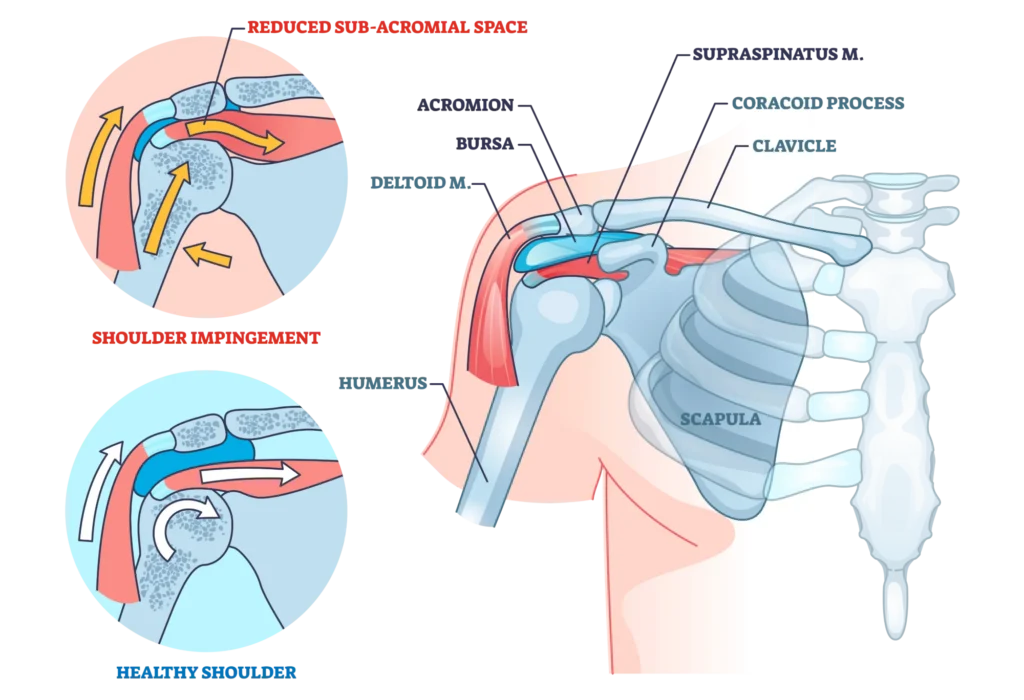
Over time, repeated compression can lead to tendon irritation, thickening of the bursa, and in more severe or long-standing cases, partial tearing of the rotator cuff itself. Catching impingement early and addressing it appropriately tends to produce much better outcomes than letting it drag on untreated.
What Causes Shoulder Impingement Syndrome?
There’s rarely a single cause. Shoulder impingement syndrome tends to develop from a combination of factors, and identifying which ones are driving the problem in a particular patient shapes how we approach treatment.
Repetitive overhead activity
Jobs or sports that involve repeated overhead motions, such as painting, swimming, baseball, tennis, or overhead pressing in the gym, place repeated stress on the rotator cuff tendons. Over time, that stress can cause the surrounding tissue to become inflamed and the effective space available to the tendons to shrink.
Shoulder blade mechanics and posture
The position and movement of the shoulder blade affects how much room the rotator cuff has to work. When the muscles around the shoulder blade are weak or imbalanced, the shoulder blade may tilt or rotate in a way that reduces subacromial space during arm movement. Rounded, forward-hunched posture can produce a similar effect. This is one of the reasons physical therapy for impingement focuses so heavily on shoulder blade position and control.
Bony anatomy
Some people are simply born with an acromion shape that narrows the subacromial space more than average. Others develop bone spurs at the edge of the acromion over time. Either of these anatomical variations can reduce the room the tendons have to move, making impingement more likely.
Age and tendon degeneration
As we get older, tendons naturally lose some of their elasticity and resilience. Degenerative changes in the rotator cuff tendons can make them more prone to swelling and irritation when compressed. Impingement tends to be more common in patients over forty, though it certainly isn’t limited to that group.
Signs and Symptoms
The classic presentation of shoulder impingement syndrome involves pain that worsens with overhead movements and activity, and improves with rest. Pain when reaching overhead or behind the back is common. Many patients describe it as a dull ache deep in the shoulder that can radiate down the outer arm. Night pain is another symptom I hear about, and a lot of the patients I see in Lincoln tell me that lying on the affected shoulder is what finally pushed them to come in.
Progressive weakness with overhead activity can develop as the condition worsens. Reaching for things on a high shelf, lifting objects away from the body, or even simple tasks like washing hair may become uncomfortable. The discomfort tends to worsen with repetitive overhead motions and ease with rest, at least early on. As impingement persists, some patients notice it becoming more constant.
One thing that’s important to understand: these symptoms can overlap with several other shoulder conditions, including rotator cuff tears, bursitis, and even early arthritis. A thorough examination is the only reliable way to sort out what’s actually going on.
What I See in My Patients
In my practice in Lincoln, Nebraska, shoulder impingement shows up across a pretty wide range of patients. I see it in active people in their thirties who have ramped up their training without building enough shoulder stability to support it. I see it in patients in their fifties and sixties whose tendons have accumulated years of wear. And I see it in people with desk jobs whose posture has quietly been loading the shoulder in the wrong way for a long time.
One pattern I see fairly often is patients who have been dealing with this for longer than they should have before seeking care. They’ve been stretching it themselves, modifying their workouts, and waiting for it to resolve on its own. Sometimes it does. More often, by the time they come in, the inflammation has had time to build.
How Is Shoulder Impingement Diagnosed?
Diagnosis starts with a detailed history and physical examination. I’ll ask about when the pain started, what makes it better or worse, and whether any specific activity or incident seemed to trigger it. The physical exam includes testing range of motion, strength, and provocation tests specifically designed to reproduce the compression that occurs with impingement.
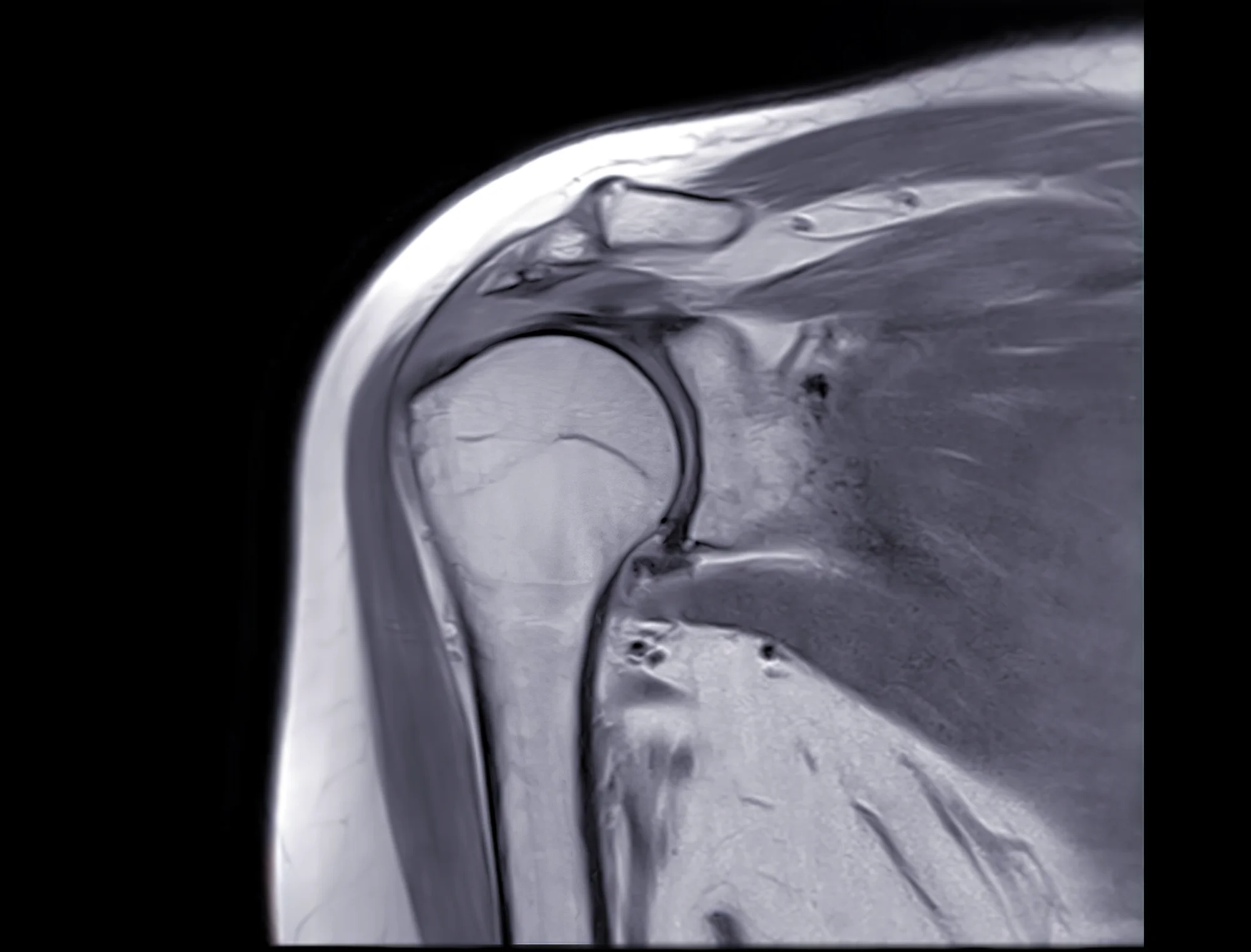
Imaging plays a supporting role. X-rays can reveal the shape of the acromion, the presence of bone spurs, and any changes in the joint itself. They can also help rule out other causes of shoulder pain, such as arthritis or a fracture. An MRI may be ordered when there’s reason to think the rotator cuff tendons may be involved, since MRI can visualize soft tissue in a way that X-rays cannot.
A diagnostic injection into the subacromial space can also be useful. If injecting a small amount of local anesthetic into that space significantly relieves the pain, it provides good evidence that impingement is the primary driver of symptoms rather than something deeper in the joint.
My Approach to Treatment
My first priority with shoulder impingement is almost always conservative treatment, and I mean that genuinely. For most patients, a well-executed non-surgical plan is enough to get them where they need to be. Surgery is a conversation I reserve for situations where we’ve genuinely exhausted the non-operative options.
Rest and activity modification
The first step is reducing the load on the irritated tissue. That doesn’t necessarily mean stopping all activity, but it does mean pulling back from overhead movements, heavy lifting, and anything that consistently provokes pain. Continuing to push through symptomatic impingement tends to perpetuate the inflammation rather than resolve it.
Physical therapy
This is typically the backbone of impingement treatment, and it’s where I see the biggest differences in outcomes between patients who commit to it and those who don’t. Physical therapy for shoulder impingement focuses on strengthening the muscles that control the shoulder blade and improving its mechanics during arm movement. The goal is to restore proper spacing and reduce the mechanical compression that’s driving the problem. Most of my patients need two to three months of consistent PT before they start feeling a real difference.
Medications
Anti-inflammatory medications can help manage pain and swelling, particularly in the earlier phases of treatment. They work best as a support tool alongside therapy, not as a standalone solution.
Corticosteroid injections
An injection of corticosteroid into the subacromial space may provide meaningful short-term pain relief, particularly in patients who are struggling to participate in therapy due to pain. The relief tends to be temporary, and I don’t think of injections as a cure, but in some cases, they can create a window where physical therapy becomes more tolerable and more productive.
Arthroscopic surgery
When symptoms persist despite several months of appropriate conservative treatment, arthroscopic surgery may be considered. The procedure involves removing inflamed bursal tissue and, in some cases, shaving down the undersurface of the acromion to create more room for the rotator cuff tendons. It’s done through small incisions, and most patients go home the same day. Recovery from arthroscopic decompression typically involves a period of rehabilitation before returning to overhead activities and sports, which may require three months or longer.
Summary
Shoulder impingement syndrome is common, and for most patients it’s treatable. The rotator cuff tendons get compressed in the narrow subacromial space, leading to pain, inflammation, and gradual loss of function if left alone. A combination of activity modification, targeted physical therapy, and anti-inflammatory treatment resolves the problem for a majority of patients. When conservative care isn’t enough, arthroscopic surgery can create additional space and address any tissue damage in a way that allows for a meaningful recovery.
If shoulder pain has been limiting your daily life, the most useful next step is to get an accurate diagnosis. Schedule an appointment to find out what’s driving your symptoms and put together a plan that’s built around your specific situation.
Frequently Asked Questions
Can shoulder impingement go away on its own?
Mild cases sometimes improve with rest and activity modification alone. More commonly, the underlying mechanics that caused the impingement don’t resolve without directed physical therapy. Waiting too long tends to allow inflammation to build and the recovery timeline to lengthen. If symptoms have persisted for more than a few weeks without improvement, an evaluation is a good idea.
Is shoulder impingement the same as a rotator cuff tear?
Not exactly, though the two are related. Impingement refers to the compression of the rotator cuff tendons in the subacromial space. A rotator cuff tear is actual structural damage to one or more of those tendons. Chronic impingement can contribute to a tear developing over time, and in some patients both conditions are present at the same time. Distinguishing between them matters because the treatment approach may differ.
When should I consider seeing a shoulder specialist for impingement?
If shoulder pain has persisted for more than a few weeks, is interfering with sleep or daily activities, or hasn’t responded to basic rest and over-the-counter medications, it’s worth getting a proper evaluation. A shoulder specialist can confirm whether impingement is actually what’s going on, rule out other contributing conditions, and put together a treatment plan that gives you the best chance of a good outcome.