Medically reviewed by Benjamin M. Woodhead, DO
When I tell someone they are a candidate for arthroscopic rotator cuff repair, the next question is almost always about the recovery rather than the operation. That makes sense. The surgery takes an hour or two and you sleep through it, while the months afterward are yours to live. Still, I think patients do better when they understand what I am actually doing in there. A repair is not a patch or a glue job. It is built to hold torn tendon against bone long enough for your body to grow a new attachment.
Key Takeaways
- The repair reattaches torn tendon to its footprint on the humerus using small anchors set into bone.
- It is done through several small incisions with a camera, usually as a same-day outpatient procedure.
- Healing is biological, not mechanical. The stitches hold position while the tendon grows back to bone, and that takes months.
What Arthroscopic Rotator Cuff Repair Means
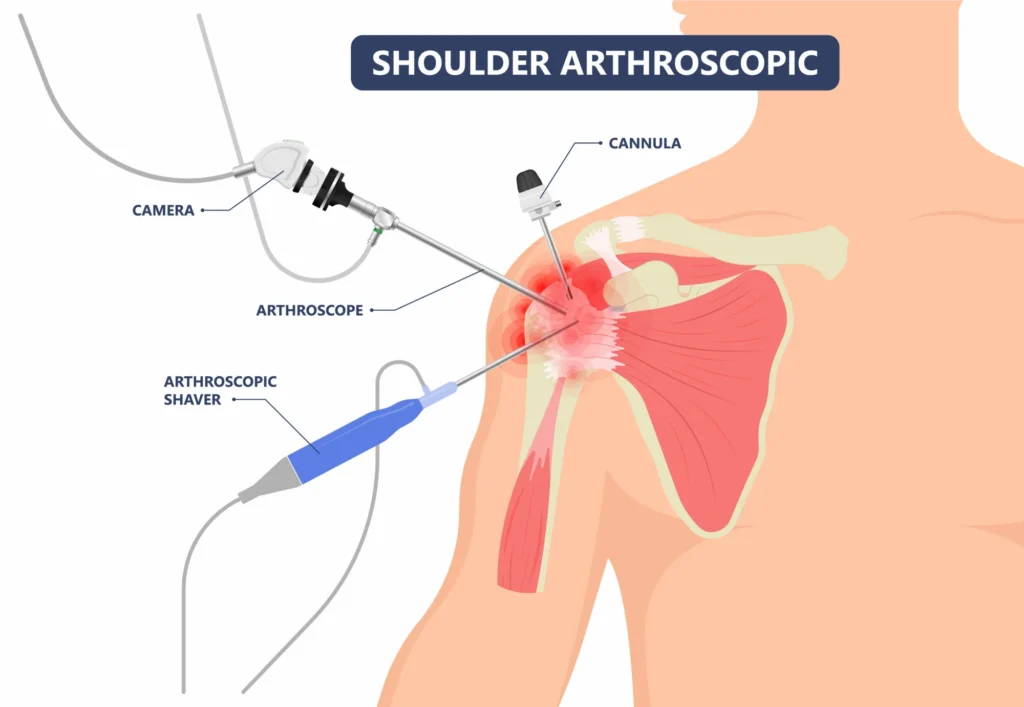
Arthroscopy describes the access, not the operation. A pencil-sized camera goes in through one small incision, instruments go in through two or three others, and I work from a monitor rather than through an open wound. Nearly all of my cuff repairs are done this way.
The repair itself is the same goal surgeons have pursued for decades. Torn tendon has pulled off the top of the arm bone, and it needs to be brought back to that spot and held there. What changed with arthroscopy is the amount of healthy tissue I have to disturb to get to it, and that difference shows up most in the first few weeks of recovery.
What Happens in the Operating Room
Most of these are outpatient procedures. You go home the same day with the arm already in a sling.
Anesthesia is typically general, combined with a regional nerve block that numbs the shoulder. The block is worth understanding, because it often works well into the next day and then wears off, sometimes abruptly. I would rather patients expect that than be alarmed by it at two in the morning.
Once you are asleep, I make the first small incision and look at the whole joint before doing anything else. Cartilage, labrum, and the biceps tendon all get inspected.
Then I clear inflamed bursal tissue to see the cuff properly, free the torn tendon so it can reach its original attachment without being yanked, and prepare the bone surface so it will bleed and heal. Small anchors go into the bone, sutures pass through the tendon, and the tendon is drawn down against the prepared footprint.
Infection prevention is a part of this I care about more than most. Some of my published research has focused on infection in shoulder surgery. I am disciplined about skin preparation and any handling of implants in the operating room.
How the Tendon Heals Back to Bone
This is the part I most want patients to take seriously. The anchors and sutures do not heal anything. They hold the tendon still against bone so that biology can do the work.
Over the following weeks, blood vessels grow into the repair site and the body builds a new attachment between tendon and bone. That interface starts out fragile. It gains strength gradually over months, and there is no way to accelerate it by being motivated.
This is exactly why the early restrictions exist. Lifting the arm with your own muscle pulls directly on the repair. That is the single behavior most likely to cause a repair to fail before it has healed.
What I See in My Patients
I played college football at Chadron State, which gave me an early and personal education in the gap between wanting to be ready and being ready. That distinction sits at the center of cuff repair recovery.
The patients who struggle are almost never the ones who lack determination. They are the ones with too much of it, aimed at the wrong six weeks. Someone feels good at week three because the block wore off and the soreness settled, so they reach for a coffee cup with the surgical arm. The shoulder feels fine. The repair does not.
Lincoln keeps me honest about this. I take care of a lot of people whose work does not pause, including farmers heading into harvest and tradespeople who are the only ones on the crew. We talk frankly about timing. Sometimes the right answer is scheduling around a season rather than around a calendar.
My Approach: Who I Repair
I recommend arthroscopic rotator cuff repair most readily for a full-thickness tear with weakness on exam, for a tear caused by a specific injury in otherwise healthy tendon, and for younger active patients where the tear will likely enlarge. High-grade partial tears that have failed a real course of therapy are also reasonable candidates, since repair generally outperforms simply cleaning up the tissue.
I am slower to recommend it when the tendon has been torn for years and the muscle has thinned or filled in with fat. Those repairs fail more often, and a patient deserves to hear that before choosing surgery rather than after. For some of those shoulders, a reverse shoulder replacement eventually serves them better than a repair that will not hold.
Recovery After an Arthroscopic Rotator Cuff Repair
Your own recovery plan comes from the tear I find and what the repair required, so exact timelines vary.
Most patients spend four to six weeks in a sling, and the exact length depends on the size of the tear and what I had to do to repair it. You take it off only for prescribed exercises. Your therapist moves the shoulder for you from the beginning, and you move your elbow, forearm, and wrist actively right away. You do not lift the arm with your own shoulder muscles during that stretch. Passive motion goals climb steadily through those weeks.
Active motion generally begins once the sling comes off. Lifting the arm out to the side is usually held back a few weeks longer, and adding resistance in that position waits longer still, because abduction pulls hardest on a healing repair. Somewhere around the three-month mark the goal is full active motion, and progressive strengthening begins from there.
From three months onward the work becomes progressively more demanding, moving from controlled low-velocity exercise toward job and sport-specific patterns between four and six months. Return to sport is decided by strength, control, and confidence rather than by a date on the calendar.
Massive tears are protected noticeably longer at every stage, because those repairs have less margin for error. If that describes your tear, I will tell you so before surgery and we will plan around it.
Before surgery, my guide on preparing for rotator cuff surgery covers the home setup and the help you will want lined up in advance.
Summary
Arthroscopic rotator cuff repair reattaches torn tendon to bone through small incisions, using anchors and sutures to hold the repair while your body builds a new attachment. The operation is short and outpatient, but the healing is biological and takes months. That is why recovery after a repair is far more protected than after arthroscopy alone.
If you have a known tear and are weighing surgery, the most useful next step is a visit where we review your images together and talk honestly about timing, your work, and what the first three months would require of you. Schedule an appointment at my Lincoln office to set that up.
Frequently Asked Questions
How long does arthroscopic rotator cuff repair take?
Most repairs take roughly one to two hours in the operating room, depending on tear size and what else I find once I am looking at the joint. Nearly all are outpatient, so you go home the same day with the arm in a sling.
How long will I be in a sling?
Most patients wear a sling for four to six weeks after a rotator cuff repair, removed only for prescribed exercises. The exact length depends on tear size and what the repair required. Massive tears follow a more protected course. Shoulder arthroscopy without a tendon repair is different, and that sling usually comes off within a few days.
When can I drive?
Not while the arm is immobilized and not while taking narcotic pain medication. For most patients recovering from a cuff repair, driving becomes realistic once the sling comes off and shoulder control returns. I make that call individually.
What happens if the repair does not heal?
Retears do occur, more often with larger tears and poorer tissue quality. Many patients with an imperfectly healed repair still function well and remain satisfied, while others need further evaluation. Options range from continued therapy to revision surgery, depending on the shoulder.
When can I return to work?
Desk work can often resume within a couple of weeks, with the arm still protected. Physical or overhead work after a cuff repair usually waits at least six months, and heavy labor can take longer, guided by strength and control rather than the date. We plan this around your specific job before surgery, not after.