Medically reviewed by Benjamin M. Woodhead, DO | Reviewed May 2026
If you’ve been dealing with deep shoulder pain, a persistent clicking or catching sensation, or a shoulder that simply doesn’t feel as stable as it used to, a labral tear in the shoulder may be worth looking into. I see this type of injury regularly in my Lincoln, Nebraska practice. It tends to affect a wide range of people, including competitive athletes, recreational players, and individuals who’ve had a bad fall or a dislocation. In this post, I’ll walk through what the labrum is, how labral tears happen, what symptoms tend to show up, and what your treatment options may look like.
Key Takeaways
- A labral tear in the shoulder involves damage to the ring of cartilage that lines the shoulder socket, which can lead to pain, catching, and a sense of instability.
- Tears can develop from a single traumatic event such as a dislocation or fall, or they may build gradually from repetitive overhead use over time.
- Treatment options range from activity modification and physical therapy to arthroscopic repair, depending on the severity and how the tear affects your daily life.
What Is the Labrum, and Why Does It Matter?
The shoulder is a ball-and-socket joint. The ball, which is the rounded top of the upper arm bone called the humeral head, sits in a shallow socket on the shoulder blade known as the glenoid. That shallowness is actually part of what gives the shoulder its remarkable range of motion. You can lift, rotate, and reach in nearly every direction. But that same design means the joint doesn’t have a lot of inherent bony stability. It relies heavily on the surrounding soft tissues to keep everything in place.
The labrum is a key part of that system. It’s a ring of firm, fibrous cartilage that wraps around the rim of the socket, essentially deepening it and increasing the contact area between the ball and the socket. Think of it like a bumper or a gasket that helps keep the ball seated properly. The labrum also serves as an attachment point for several important stabilizing ligaments and for the biceps tendon at the top of the joint.
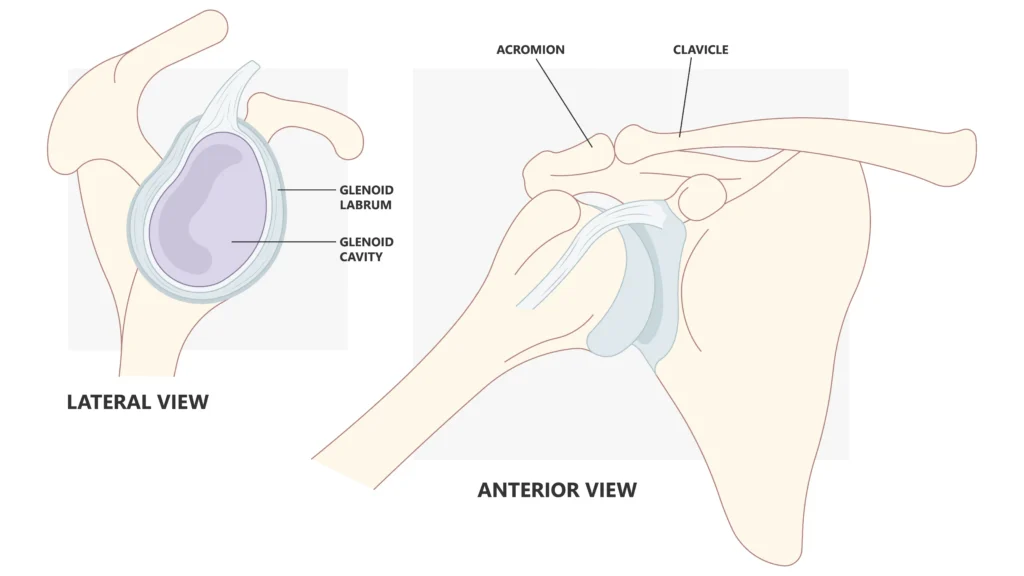
When the labrum is intact and healthy, it contributes meaningfully to shoulder stability and smooth movement. When it’s torn, the shoulder can lose some of that stability, and patients often notice the difference.
What Causes a Labral Tear in the Shoulder?
Labral tears tend to fall into two main categories: those that happen suddenly from a traumatic event, and those that develop gradually from repetitive stress.
Traumatic causes are often forceful and abrupt. A shoulder dislocation is one of the most common triggers. When the ball of the joint slips out of the socket, typically forward and downward, it can tear the labrum from the socket rim as it goes. Falls onto an outstretched arm can also drive force through the shoulder and injure the labral tissue. Contact sports, sudden overhead loads, and forceful pulling or catching motions may also cause acute tears.
Repetitive overhead use tends to be a slower process. In overhead athletes such as pitchers, swimmers, volleyball players, and tennis players, the shoulder is subjected to thousands of loading cycles over time. This repetitive stress may gradually fray or tear the labrum, particularly at the top of the socket where the biceps tendon attaches. Mechanics play a role here too. When movement patterns are off or fatigue sets in, forces on the labrum can increase.
Age is also worth mentioning. As we get older, the labrum can lose some of its flexibility and resilience, making it more susceptible to tearing even without a specific traumatic event.
Types of Labral Tears
The labrum is a full ring, so tears can occur at different points around the socket. The location matters because it tends to determine the symptoms a patient experiences and helps guide treatment decisions.
SLAP tears, which stands for Superior Labrum Anterior to Posterior, affect the top of the labrum, specifically where the biceps tendon anchors into the socket. These are particularly common in overhead athletes and can also result from falls on an outstretched or reaching arm. People with SLAP tears often describe a deep aching pain in the shoulder, discomfort with overhead movements, and sometimes a clicking or popping sensation during throwing or lifting.
Bankart lesions affect the lower front portion of the labrum and are closely tied to shoulder dislocations. When the ball slips forward out of the socket, it tends to tear this specific region on its way out. Bankart lesions are commonly associated with persistent shoulder instability after a dislocation because important stabilizing structures of the shoulder have been injured.
Shoulder instability and dislocations and labral tears often go hand in hand, and addressing one may mean addressing the other. A thorough evaluation helps identify exactly what is going on.
Symptoms of a Labral Tear in the Shoulder
The symptoms of a labral tear in the shoulder can vary quite a bit from person to person. Some patients come in describing sudden pain that started right after a dislocation. Others describe a more gradual process, where the shoulder slowly started feeling unreliable after months of heavy training.
Symptoms that may accompany a labral tear include:
- Deep aching pain within the shoulder joint itself, often difficult to point to with a single finger
- Clicking, popping, or catching sensations with certain movements, particularly rotation or overhead activity
- A sense of instability, including a feeling that the shoulder could slip, give way, or simply isn’t trustworthy
- Weakness with overhead activities, pushing, pulling, or throwing
- Pain during specific movements such as reaching across the body, lifting away from the body, or following through on a throw
- Discomfort that tends to worsen with activity and may linger well after stopping
Not every labral tear causes dramatic symptoms. Some tears may produce relatively mild discomfort, while others significantly limit what a person can do.
How Is a Labral Tear Diagnosed?
Getting an accurate diagnosis starts with a conversation. I’ll ask about when symptoms began, what seems to make them better or worse, whether there was a specific injury, and what your activity level looks like. Details about your sport, occupation, or training habits are helpful too, as they paint a picture of the demands being placed on the shoulder.
A physical examination follows. I’ll assess your range of motion, strength, and stability, and I may perform specific clinical tests designed to stress the labrum and check for signs of instability.
Imaging is usually part of the diagnostic process as well. X-rays help rule out fractures and assess bone alignment. Since the labrum is soft tissue, an MRI tends to give us a much clearer picture. In some cases, an MRI arthrogram may be ordered, which involves injecting contrast dye into the joint before imaging to improve the visibility of smaller or subtler tears. Putting together the anatomy on imaging, the clinical examination findings, and your symptom history helps determine the most appropriate next steps.
Treatment Options
A labral tear in the shoulder doesn’t automatically mean surgery. Treatment is highly individualized, and the right approach depends on the type and location of the tear, the degree of instability, your activity level, and your goals for recovery.
Non-Surgical Treatment
For many patients, conservative management is a reasonable first step. Activity modification, which means temporarily pulling back from the activities that are aggravating the shoulder, gives irritated tissue a chance to settle. Physical therapy then focuses on strengthening the muscles around the shoulder and shoulder blade, improving movement mechanics, and reducing the strain placed on the labrum during daily activity. Anti-inflammatory medications may help manage pain and swelling, and targeted injections may also be considered when symptoms need more direct control. In my experience, patients who commit to that strengthening program early on tend to see the best results from conservative care.
Some patients see meaningful improvement over several weeks of consistent conservative care. Others find that symptoms plateau or that a sense of instability continues to limit daily function or athletic performance.
Surgical Treatment
When conservative treatment hasn’t provided adequate relief, or when significant instability is the primary concern, arthroscopic repair may be discussed. This is a minimally invasive procedure that uses small incisions and a camera to work inside the joint. The torn labrum is reattached to the socket rim using small anchors and sutures with the goal of improving shoulder stability.
The decision to pursue surgery is something I work through carefully with each patient. We talk about realistic expectations, what recovery involves, and how it aligns with your personal goals.
Summary
A labral tear in the shoulder can range from a mild, manageable issue to a significant source of pain and instability, depending on the tear’s location, severity, and the demands placed on the shoulder. The good news is that treatment options are available, ranging from conservative physical therapy and activity modification to arthroscopic repair for cases that warrant a more definitive solution.
Frequently Asked Questions
Can a labral tear in the shoulder heal on its own?
Minor labral tears may improve with conservative treatment, rest, and physical therapy. The labrum has limited blood supply, which can make natural healing more difficult for larger or more complex tears. Tears associated with significant instability are less likely to resolve fully without surgical intervention. Getting an evaluation helps determine where your specific tear falls on that spectrum and what the most appropriate approach may be.
How long does it take to recover from a labral tear?
Recovery timelines vary depending on the treatment approach. Nonoperative care may produce noticeable improvement over several weeks for some patients. After arthroscopic repair, rehabilitation typically progresses over several months, with return to full activity guided by how healing and strength develop rather than a set calendar date. Your individual anatomy, the severity of the tear, and consistency with rehabilitation all play a role.
Am I a good candidate for labral repair surgery?
That depends on several factors, including the type and location of the tear, the degree of instability, your age and activity level, whether conservative treatment has been tried, and what your recovery goals look like. The most reliable way to answer that question is to come in for a consultation. I’ll review your imaging, examine the shoulder, and have a direct conversation about what makes sense for your specific situation.